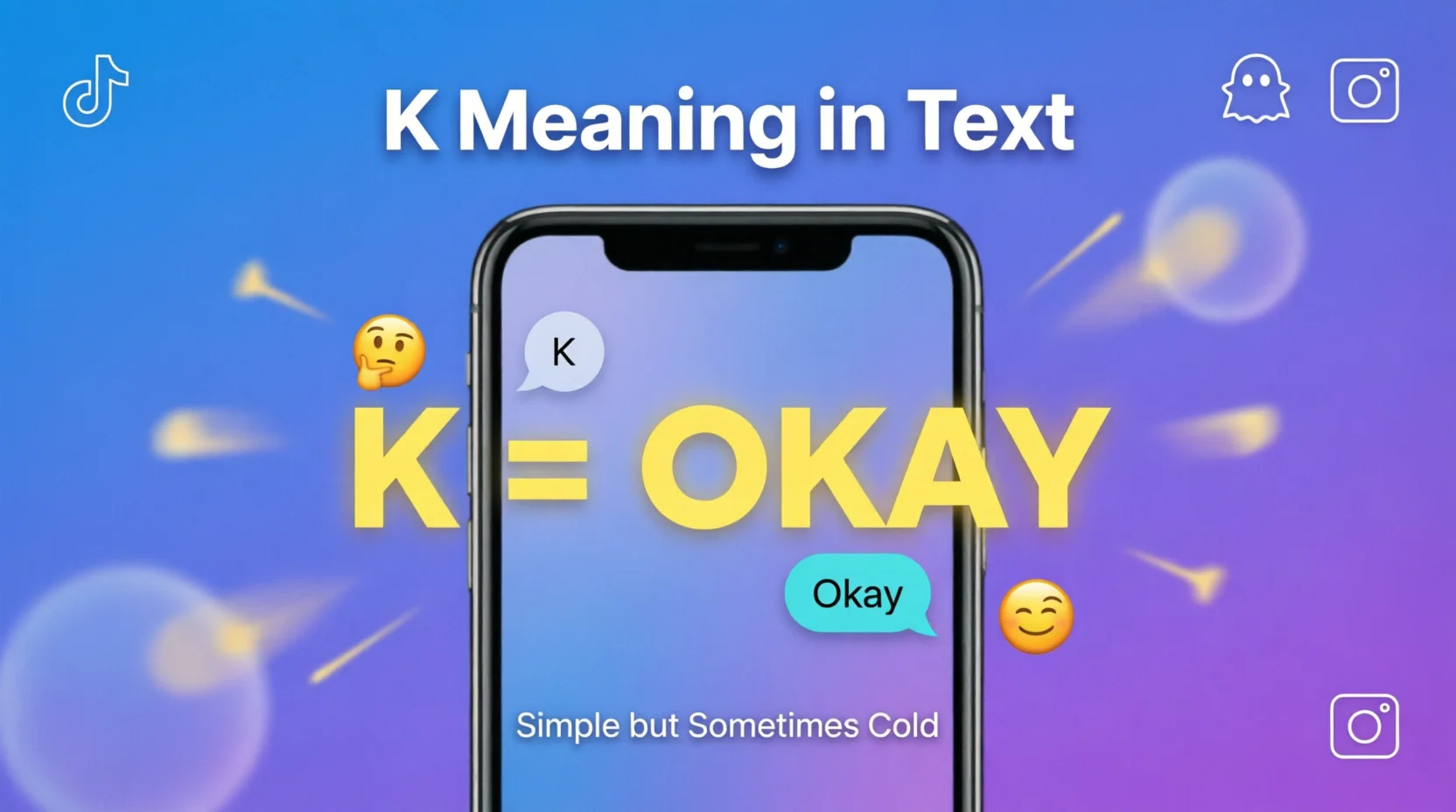
“K” in text simply means “okay,” but it often feels short, cold, or even slightly annoyed depending on the situation. People commonly see it on TikTok, Snapchat, Instagram, and in everyday texting. Many search for it because its tone can be confusing.
In one message, it can mean agreement. In another, it can feel dismissive.
That’s why understanding context matters.
This guide breaks it down in a simple, real-world way so you don’t misread it—or use it the wrong way.
K Meaning in Text
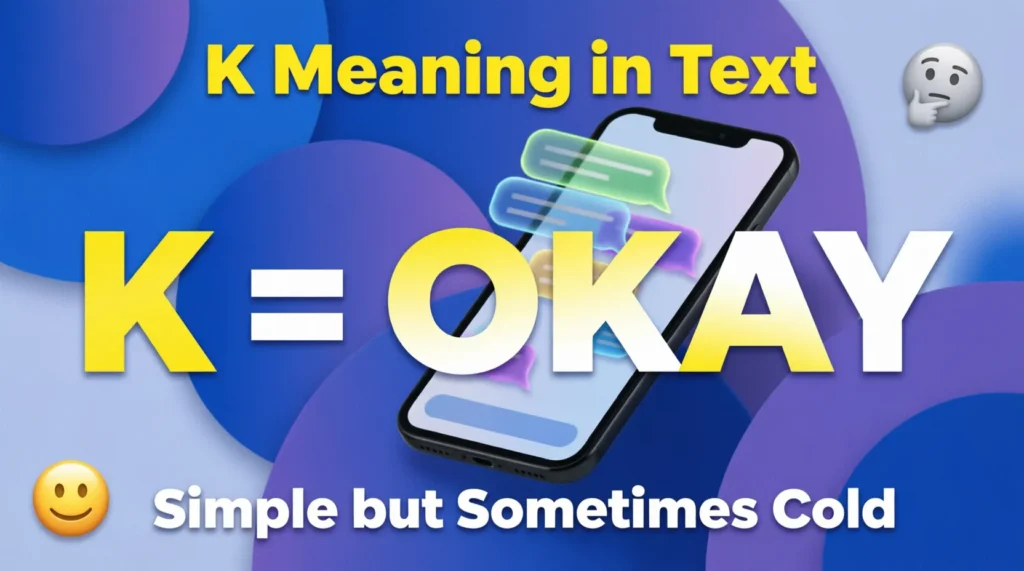
The letter “K” is a shortened version of “OK” or “Okay.”
It’s not an acronym. It’s more of an abbreviation or casual slang.
In everyday chat, it usually means:
- “Okay”
- “Got it”
- “Fine”
But here’s the important part: tone changes everything.
When someone writes “okay,” it feels normal.
When someone writes “k,” it can feel:
- blunt
- uninterested
- annoyed
That’s why people sometimes overthink it.
For example:
“Okay, sounds good!” → friendly
“K.” → possibly cold
So while the meaning is simple, the feeling behind it isn’t always.
Where People Use K
You’ll see “K” almost everywhere online. It’s one of the shortest replies possible, which makes it popular in fast conversations.
TikTok
On TikTok, “K” appears in comments and replies. It’s often used when someone doesn’t want to argue or just wants to end a conversation quickly.
Example:
“k, whatever”
Snapchat
On Snapchat, “K” is very common in chats.
But here, tone matters a lot. A single “k” can sometimes signal:
- disinterest
- short replies
- mood changes
That’s why people often ask, “Why did they just say ‘k’?”
On Instagram DMs, “K” is used in quick replies.
It’s usually neutral, but if the conversation was long or emotional, it might feel dismissive.
On WhatsApp, especially in casual chats, “K” is used for fast confirmation.
Example:
“Meet at 5?”
“K”
Simple and efficient.
SMS (Text Messages)
In regular texting, “K” has been around for years.
Older users may use it normally. Younger users sometimes read more into it emotionally.
Real Chat Examples
Here are 10 realistic texting conversations to show how “K” is used:
1
A: I’ll call you later
B: K
A: 👍
2
A: Did you finish the work?
B: K, I’ll do it now
A: Thanks
3
A: I can’t come today
B: K
A: Maybe tomorrow
4
A: You forgot again
B: K… sorry
A: It’s fine
5
A: Let’s meet at 7
B: K
A: Don’t be late
6
A: I was just joking
B: K
A: Why are you mad?
7
A: Send me the file
B: K
A: Waiting
8
A: I think we should talk
B: K
A: When are you free?
9
A: I got the tickets
B: K nice
A: It’ll be fun
10
A: You okay?
B: K
A: That doesn’t sound okay
These examples show how “K” can feel different depending on the situation.
How to Reply When Someone Says “K”
Replying to “K” depends on the tone you think they’re using.
Funny Replies
- “That’s the shortest message ever 😂”
- “Wow, full sentence today?”
- “You okay or just typing fast?”
Casual Replies
- “Cool 👍”
- “Alright”
- “Got it”
Friendly Replies
- “Okay 😊”
- “Sounds good!”
- “Thanks!”
Neutral Replies
- “Noted”
- “Alright, I’ll proceed”
- “Okay, thanks”
If you feel the “K” sounded cold, you can ask:
“Everything okay?”
That helps clear confusion.
Is K Rude or Offensive?
“K” is not inherently rude.
But it can feel rude depending on how it’s used.
When it feels fine:
- Quick confirmations
- Busy conversations
- Casual chats
When it feels rude:
- During serious conversations
- When someone expected a longer reply
- When used repeatedly in emotional chats
At school or work, it’s safer to avoid “K” and use:
- “Okay”
- “Sure”
- “Got it”
It sounds more polite and professional.
Who Uses This Term?
“K” is used by almost everyone, but the interpretation varies by age.
Age Groups
- Gen Z: Uses it often but reads deeper meaning into it
- Millennials: Use it casually, usually without emotional intent
- Older users: Often see it as just “okay”
Platforms
It’s common on:
- Messaging apps
- Social media DMs
- Comment sections
Frequency
“K” is extremely common because:
- It’s fast
- It saves time
- It ends conversations quickly
But that same simplicity can sometimes cause confusion.
Origin of the Term
“K” comes from shortening “OK.”
The word “OK” itself has an interesting history going back to the 1800s, but in texting culture, people shortened it further to just “K.”
Why?
Because texting evolved toward speed and efficiency.
Typing “k” takes less effort than “okay.”
Over time, internet culture added emotional meaning to it. What started as a simple shortcut became something people analyze more deeply.
The exact moment it became “cold” or “dry” isn’t clear—but social media played a big role.
Real-World Usage Example
Imagine you’re texting a friend:
You: “Let’s meet at the café at 6.”
Friend: “K”
If everything is normal, this just means “okay.”
But if you were discussing something serious before, that same “K” might feel like:
- they’re annoyed
- they don’t want to talk
- they’re ending the conversation
That’s why context is everything.
Frequently Asked Questions
What does K mean in text messages?
It means “okay” or “got it.” It’s a short and quick reply.
What does K mean on TikTok?
On TikTok, it usually means agreement, but it can sometimes feel dismissive depending on tone.
Is K slang?
Yes, it’s considered informal internet slang or a texting abbreviation.
Is K rude or offensive?
Not directly, but it can feel rude if used in serious or emotional conversations.
How should you reply to K?
Reply based on context. You can respond casually, ask a question, or keep the conversation going.
Conclusion
In conclusion, “K” in text simply means “okay,” but its tone can change depending on the situation. It’s commonly used in quick, casual chats on platforms like TikTok, Snapchat, and WhatsApp. While it’s fine for short confirmations, it may come across as cold or uninterested in more serious conversations.
To avoid confusion, it’s better to use “okay” or a slightly longer reply when tone matters. Understanding how and when to use “K” helps you communicate more clearly and avoid misunderstandings in everyday texting.
discovr more post
What Does TFW Meaning in Text? Real Meaning, Examples & Social Media Use2026
What Does Emoji Meaning in Text Mean? Real Meaning, Examples & Social Media Use2026
What Does SD Meaning in Text? Real Meaning, Examples & Social Media Use2026

Ella Johnson is a creative humor writer and content specialist at Punzdaily.com, where she crafts clever, clean, and shareable puns, jokes, and one-liners. With a passion for wordplay and everyday laughter, Ella writes witty content that connects with global audiences on Instagram, WhatsApp, Facebook, and casual conversations. Her playful style, simplicity, and universal humor make her a top choice for readers looking for smart, fun entertainment.